What if the real cost of thyroid surgery isn’t measured in dollars alone? As robotic techniques gain attention, many patients wonder whether innovation truly delivers better outcomes than tradition. By starting with something as routine as an ultrasound for thyroid, this discussion uncovers a hidden trade-off that could change how you evaluate robotic vs. traditional thyroidectomy—and whether the price tag is really worth it.
TL;DR
Robotic and traditional thyroidectomy offer comparable safety, oncologic outcomes, and long-term results when patients are properly selected and followed. Robotic surgery stands out for cosmetic benefits (no visible neck scar), faster recovery, and improved surgical visualization, while traditional surgery remains the established standard with extensive clinical experience. The choice between techniques depends on patient factors, surgical indication, and team expertise, and more long-term comparative evidence is still needed.
Learn more by speaking with a thyroid specialist

How Does Robotic Thyroid Surgery Compare in Safety?
Safety is one of the most relevant factors when comparing robotic thyroidectomy with traditional approaches. Knowing how the procedure is performed, which patients are considered candidates, and what measures are taken before, during, and after surgery helps clarify whether this technology offers an appropriate safety profile for certain thyroid conditions.
Robotic thyroidectomy is presented as a surgical option for patients with specific thyroid gland conditions, including certain types of cancer, goiter, or benign nodules. The thyroid is located below the larynx and around the trachea and plays a key role by producing thyroid hormone, which regulates body energy and temperature. Indicating robotic surgery depends on patient-specific and disease-related criteria, which directly affect procedural safety.
Robotic thyroidectomy includes multiple steps designed to reduce risk and support controlled recovery when applied to carefully selected patients. Procedure safety depends not only on the technology used, but also on proper indication, precise surgical execution, and consistent postoperative follow-up.
Patient Assessment and Surgical Selection
Patient evaluation is a foundational step before considering any type of thyroidectomy, whether robotic or traditional. This process confirms the diagnosis, assesses disease severity, and identifies which patients are appropriate candidates for each surgical technique. Proper selection aims to balance safety, effectiveness, and the true scope of the procedure based on individual clinical characteristics.
Preoperative Patient Evaluation
Preoperative evaluation combines clinical information, laboratory studies, and imaging to provide a complete picture of the patient’s condition.
Medical History and Physical Examination
- Common symptoms include difficulty swallowing or breathing, voice changes, fatigue, and weight gain.
- Neck palpation assesses gland size, consistency (a firm texture may suggest malignancy), mobility, and enlarged lymph nodes.
Laboratory Tests
- Thyroid function tests (TSH, T3, T4) help identify hypo- or hyperthyroidism.
- Serum calcium levels are useful for evaluating parathyroid gland function and postoperative management.
Imaging and Diagnostic Studies
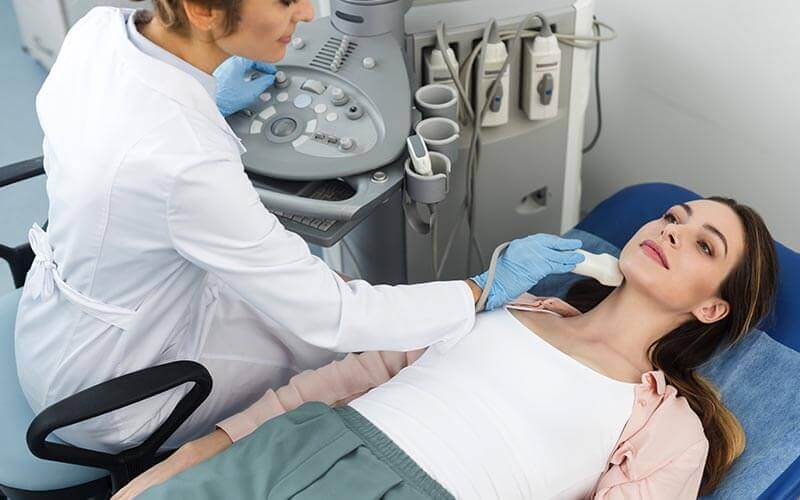
- Thyroid ultrasound identifies nodules, evaluates size and characteristics, and helps determine surgical techniques, such as endoscopic approaches for nodules smaller than 3 cm.
- Fine-needle aspiration biopsy (FNAB) is used to confirm or rule out malignancy in suspicious nodules.
Additional Assessments
- Voice evaluation assesses baseline vocal function prior to surgery.
- Cardiac evaluation includes an electrocardiogram as part of the preoperative workup.
Surgical Technique Selection
The choice of surgical technique depends on pathology type, nodule size, and patient conditions.
- Partial Thyroidectomy (Hemithyroidectomy): Removal of one lobe, indicated for benign nodules or small cancers, with the goal of preserving thyroid function.
- Total Thyroidectomy: Complete gland removal, required for multifocal or more advanced cancers.
A comprehensive evaluation and appropriate surgical selection help define the most suitable thyroidectomy type for each patient. Considering symptoms, diagnostic studies, nodule size, and overall clinical status allows clinicians to determine the need for surgery and the technique that best matches the condition, prioritizing safety and outcomes.
Preoperative Preparation for Each Technique
Preoperative preparation is an essential component of both robotic and traditional thyroidectomy. This process reduces risk, optimizes hormonal status, and ensures surgery is performed under optimal conditions. While both techniques share several steps, each includes specific considerations based on the surgical approach.
| Aspect | Robotic Thyroidectomy | Traditional Thyroidectomy |
| Medical evaluation | Lab tests, ultrasound, laryngoscopy | Lab tests, hormonal control |
| Hormonal optimization | Medication or iodine if needed | Medication, beta-blockers, iodine |
| Fasting | 8–12 hours | 8–12 hours |
| Medications | Supervised anticoagulant suspension | Medication review and adjustment |
| Personal preparation | Comfortable clothing, documents | Comfortable clothing, no jewelry, companion |
Proper preoperative preparation supports risk reduction and ensures each technique is carried out under appropriate conditions, tailored to clinical needs and the selected surgical approach.
Execution of the Chosen Surgical Method
Each approach follows a structured sequence aimed at removing all or part of the thyroid gland while protecting vital structures such as the laryngeal nerves and parathyroid glands. The main difference lies in access type, instrumentation, and how the surgeon interacts with the surgical field.
Robotic Thyroidectomy
Robotic thyroidectomy is a minimally invasive procedure performed using robotic arms controlled remotely by the surgeon, supported by enhanced three-dimensional visualization and high precision.
Remote Surgical Approaches
- Transoral approach (TOETVA): Small incisions are made inside the oral cavity, allowing direct access to the thyroid without visible neck scars.
- Axillo-breast approach (BABA): Access is gained through incisions in the armpit and breast area, creating a subcutaneous tunnel to the neck.
Instrumentation and Dissection
- The robotic system and endoscopic camera are introduced through ports.
- From a console, the surgeon manipulates robotic instruments to separate prethyroid muscles, mobilize the thyroid lobe, seal blood vessels, and divide the isthmus.
Identification of Vital Structures
- Intraoperative neuromonitoring helps identify and protect the recurrent laryngeal nerve, which is essential for voice function.
- Parathyroid glands are identified and preserved.
Specimen Removal and Closure
- The thyroid specimen is removed in a retrieval bag through one of the ports.
- Small incisions are closed, leaving no visible neck scar.
Traditional Thyroidectomy
Traditional thyroidectomy is performed through a direct neck approach and remains a widely used method for thyroid gland removal.
Procedural Steps
- Anesthesia: The patient receives general anesthesia.
- Incision: A horizontal incision is made in the lower anterior neck, typically along a natural skin fold to minimize scar visibility.
- Dissection and Removal
- Tissues are carefully separated to access the thyroid.
- The recurrent laryngeal nerve and parathyroid glands are identified and protected.
- Partial or total gland removal is performed with vascular control based on clinical indication.
- Control and Closure
- The surgical field is checked for bleeding.
- Temporary drains may be placed if needed.
- The incision is closed with sutures, leaving a visible neck scar.
Both robotic and traditional thyroidectomy follow defined steps to safely remove the gland and preserve vital structures. Robotic surgery relies on remote access and advanced technology to avoid visible scarring, while traditional surgery uses direct neck access with a controlled and precise approach.
Post-Surgery Management and Safety Checks
Postoperative management after thyroidectomy helps detect early complications and supports safe recovery. Clinical monitoring focuses on symptom surveillance, surgical wound care, and patient education to recognize warning signs.
Early complications to monitor
- Recurrent laryngeal nerve injury: hoarseness, weak voice, difficulty speaking or swallowing.
- Hypocalcemia (24–48 hours): tingling, arrhythmias, muscle spasms, anxiety.
- Cervical hematoma: breathing difficulty, neck swelling, bleeding, pain, or pressure.
Any of these signs require immediate notification of healthcare staff.
Care during hospitalization
- Surgical wound: monitor for infection, keep dressing clean and dry, avoid manipulation.
- Drain: do not pull or manipulate; report displacement or accidental removal.
Home care
- Do not remove dressings until follow-up.
- Clean with water and mild soap.
- Dry carefully based on dressing type.
- Check daily for signs of infection.
- Avoid direct sun exposure.
- Follow rest, diet, and medication instructions.
When to seek care
- Delayed bleeding.
- Wound opening or suture loss.
- Signs of infection.
- Fever above 38 °C.
Appropriate postoperative follow-up allows early detection of complications and supports safe recovery through symptom monitoring, wound care, and timely medical consultation.
Follow-Up and Outcome Comparison
In follow-up and outcome comparison, robotic thyroidectomy shows oncologic and long-term results similar to traditional thyroidectomy. Both techniques require regular monitoring of thyroid function, recurrence, and complications such as hypocalcemia or voice changes. After total thyroidectomy, thyroid hormone replacement with levothyroxine is part of routine management.
From a functional and cosmetic perspective, robotic surgery—especially via the transoral route—stands out for the absence of a visible neck scar and faster recovery. Many patients resume daily activities within days and complete overall recovery in about two weeks. Enhanced three-dimensional visualization and instrument precision allow detailed dissection with perioperative and long-term safety profiles comparable to open surgery.
Traditional thyroidectomy remains the reference standard with well-established oncologic outcomes and extensive experience. It leaves a visible neck scar and shares the same potential complications as robotic techniques.
Robotic surgery may involve a learning curve, longer initial operative times, or additional approaches in complex cases, yet it is presented as a safe and effective alternative. Overall, the choice between techniques should be based on the specific clinical case, required follow-up, and surgical team experience, while acknowledging the need for more long-term comparative evidence.
Key Takeaways
- Both approaches show similar oncologic results and complication profiles, including risks to calcium levels and vocal function. What ultimately determines safety is not the technology alone, but correct patient selection, surgical execution, and consistent follow-up.
- The absence of a visible neck scar and a faster return to daily activities are major benefits highlighted in the text. Enhanced 3D visualization and instrument precision also support detailed dissection without compromising safety.
- It continues to deliver well-documented oncologic outcomes and predictable results across a wide range of cases. However, it typically leaves a visible neck scar and does not offer the same ergonomic or cosmetic benefits as robotic approaches.
- Evaluation includes clinical history, lab tests, imaging, and functional assessments to determine candidacy and surgical extent. Proper hormonal optimization and adherence to preoperative instructions help reduce risks regardless of the chosen approach.
- While robotic surgery may involve a learning curve and longer operative times initially, it is presented as a safe and effective alternative. The text emphasizes that more long-term comparative evidence is still needed to fully define its role.
FAQs
Why would a doctor order an ultrasound of the thyroid?
A doctor may order a thyroid ultrasound to evaluate nodules or an enlarged thyroid found on physical exam. It helps determine nodule size, structure (solid or cystic), and suspicious features, and can guide biopsies or further evaluation of symptoms like voice changes or neck pain.
What are the warning signs of thyroid cancer?
Warning signs include a lump or swelling in the neck, persistent hoarseness, difficulty swallowing or breathing, and neck pain that may radiate to the ears. In many cases, thyroid cancer causes no early symptoms and is discovered during routine exams or imaging.
What are the red flags on a thyroid ultrasound?
Red flags include solid, hypoechoic nodules that are taller than wide, have irregular margins, microcalcifications, or lack a clear halo. Suspicious cervical lymph nodes may also raise concern and require further evaluation.
Can thyroid issues be seen on ultrasound?
Yes, thyroid ultrasound is a key tool for detecting and monitoring thyroid conditions such as nodules, cysts, and goiter. While it does not measure hormone levels, it provides detailed information about structure, size, and features that may suggest malignancy.
Sources
- Biello, A., Kinberg, E. C., Menon, G., & Wirtz, E. D. (2024). Thyroidectomy. In StatPearls [Internet]. StatPearls Publishing.
https://www.ncbi.nlm.nih.gov/books
- Chahardahmasumi, E., Salehidoost, R., Amini, M., Aminorroaya, A., Rezvanian, H., Kachooei, A., … & Kolahdoozan, M. (2019). Assessment of the early and late complication after thyroidectomy. Advanced biomedical research, 8(1), 14.
https://journals.lww.com/adbm/fulltext