THYROID SCAN IN QUEENS & BROOKLYN, NY
ADVANCED DIAGNOSTIC CARE AND SONOGRAM FOR YOUR THYROID HEALTH
At Atlantic Endocrinology, we understand the critical importance of accurate thyroid health assessment. Our state-of-the-art ultrasound services are designed to provide precise and detailed imaging, ensuring a comprehensive evaluation of your thyroid health. Our expert team, utilizing the latest ultrasound technology, delivers a seamless and comfortable diagnostic experience.
Whether you’re facing thyroid irregularities or require routine monitoring, our dedicated approach ensures that you receive the highest standard of care. We believe in empowering our patients with knowledge and comprehensive care, guiding them every step of the way towards optimal thyroid health.
BOOK YOUR THYROID ULTRASOUND APPOINTMENT NOW
YOUR HEALTH, OUR PRIORITY: BENEFITS OF CHOOSING OUR THYROID ULTRASOUND SERVICE
Precise Diagnostics: High-resolution imaging for accurate assessment of thyroid conditions.
Non-Invasive Procedure: A painless, safe, and efficient way to evaluate thyroid health.
Expert Team: Experienced endocrinologists and technicians specialized in thyroid imaging.
Personalized Care: Tailored diagnostic approaches to meet your specific health needs.
Swift Results: Quick turnaround for results, aiding in faster treatment planning.
OUR THYROID ULTRASOUND SPECIALISTS
Meet Our Thyroid Health Specialists – a dedicated team of endocrinologists, radiologists, and healthcare professionals committed to providing exceptional diagnostic care. Our team’s collaborative effort ensures that your thyroid health is assessed accurately and efficiently, offering peace of mind and clear direction for your health journey.
WHERE ARE WE LOCATED IN NEW YORK?
If you’re searching for the top thyroid ultrasound in New York, look no further. We’re located in Queens. Our team offers a range of services to our patients and is always eager to answer any questions you may have:
Atlantic Endocrinology & Diabetes Center: Dr 1 FL, Rego Park
- 97-25 63 Dr 1 FL, Rego Park, NY 11374
- Monday – Thursday: 9 AM – 7 PM
- Friday: 8 AM – 5 PM
- Saturday: Closed
- Sunday: 8 AM - 6 PM
- +1 (718) 275-2900
Atlantic Endocrinology & Diabetes Center: Rd Suite 103, Queens
- 99-45 67th Rd Suite 103, Forest Hills, NY 11375
- Monday 9 AM – 5 PM
- Tuesday 9 AM – 5 PM
- Wednesday: Closed
- Thursday 9 AM – 5 PM
- Every other Friday 9 AM – 5 PM
- Saturday & Sunday: Closed
- +1 (718) 275-2900
Better Health by Atlantic Endocrinology & Diabetes Clinic
- 97-32 63rd Rd, Rego Park, NY 11374
- Monday – Thursday 9 AM – 7 PM
- Friday: Closed
- Saturday and Sunday: Closed
- (718) 275 - 2900
MEDICAL SERVICES ACROSS QUEENS & BROOKLYN NEIGHBORHOODS
With locations in Queens and Brooklyn, Atlantic Endocrinology & Diabetes Center proudly provides expert, patient-focused medical care to Elmhurst, Kew Gardens, Richmond Hill, Glendale, Downtown Brooklyn, Flushing, and surrounding neighborhoods.
Here is a short video to talk about Ultrasound for thyroid:
WHAT IS A THYROID ULTRASOUND AND WHY IS IT IMPORTANT FOR YOUR THYROID HEALTH?
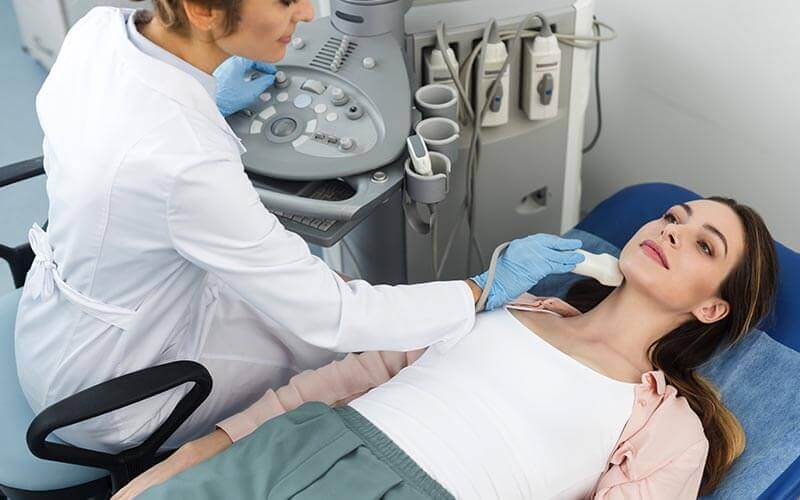
Ultrasound examination is the most accurate and useful imaging test to detect nodules or lumps within the thyroid gland. Ultrasound procedure uses sound waves to produce images of the thyroid gland and the images can be captured to assess the size, shape, structure and any abnormalities of the thyroid gland.
Accurate measurement of the size of the thyroid nodules can be made using ultrasound imaging. It also assists in the evaluation of the variations in the thyroid tissue such as enlargement caused by goiter and decrease in size caused by inflammation and can differentiate between the solid, fluid-filled or complex type of thyroid nodules.
WHY WOULD I NEED
A THYROID ULTRASOUND?
The reasons for the administration of a Thyroid Ultrasound are to diagnose dysfunction or suspected abnormalities of the thyroid gland. It may be used to:
• Determine the existence of a goiter, an enlargement of the thyroid gland.
• Assess whether a lump has originated on the thyroid gland or elsewhere.
• Determine whether a detected mass is growing.
• Differentiate between cysts, filled with fluid, and solid masses.
• Help determine whether an abnormal growth may be malignant.
WHAT DOES A THYROID ULTRASOUND SCAN DETECT?
The role of ultrasound in the diagnosis of thyroid conditions is complex and involves detection of the thyroid and neck masses, distinguishing between benign and malignant nodules, and guidance during fine needle aspiration (FNA) biopsy and percutaneous treatment.
A Thyroid Ultrasound may be ordered if a thyroid function test is abnormal or if your doctor feels a growth on your thyroid while examining your neck. An ultrasound can also check an underactive or overactive thyroid gland.
You may receive a thyroid ultrasound as part of an overall physical exam. Ultrasounds can provide high-resolution images of your organs that can help your doctor better understand your general health. Your doctor may also order an ultrasound if they notice any abnormal swelling, pain, or infections so that they can uncover any underlying conditions that might be causing these symptoms.
Ultrasounds may also be used if your doctor needs to take a biopsy of your thyroid or surrounding tissues to test for any existing conditions.
HOW CAN A THYROID ULTRASOUND HELP WITH DIAGNOSIS?
An ultrasound can give your doctor a lot of valuable information, such as:
• If a growth is fluid-filled or solid.
• The number of growths.
• here the growths are located.
• Whether a growth has distinct boundaries.
• Blood flow to the growth.
Ultrasounds can also detect a goiter, a swelling of the thyroid gland.
FREQUENTLY ASKED QUESTIONS (FAQS)
Why would I need a thyroid ultrasound?
You may need a thyroid ultrasound to diagnose dysfunction or suspected abnormalities of the thyroid gland. Indications include assessing the presence of a goiter, determining the origin and growth of a lump, differentiating between cysts and solid masses, and evaluating the potential malignancy of an abnormal growth.
What does a thyroid ultrasound detect?
A thyroid ultrasound detects thyroid and neck masses, differentiates between benign and malignant nodules, assists in guiding fine needle aspiration biopsies, and evaluates for conditions like goiters or nodules. It can also check for underactive or overactive thyroid glands.
How long does a thyroid ultrasound take?
The duration of a thyroid ultrasound is typically short, often completed within a few minutes.
Will my insurance cover a thyroid ultrasound at Atlantic Endocrinology?
Coverage for a thyroid ultrasound depends on your specific insurance plan. It’s advisable to check with your insurance provider for details.
HEALTH INSURANCE PLANS
WE ACCEPT AT ATLANTIC ENDOCRINOLOGY