 By Atlantic Endo Medical Review Board
Last updated: May 19, 2026
Quick Answer: Hirsutism is excess, coarse hair growth in women following a male-pattern distribution — on the face, chest, abdomen, and back — and it is caused by elevated androgens (male hormones) in the body. PCOS is responsible for roughly 70–80% of all hirsutism cases. Other causes include adrenal disorders, thyroid dysfunction, certain medications, and rare tumors. A proper diagnosis requires hormone blood tests and evaluation by a qualified endocrinologist.
Speak with Endocrinologist PCOS Specialist in Queens, NY
Table of Contents
Key Takeaways
- PCOS is the leading cause of hirsutism in women of reproductive age, driven by excess androgens and insulin resistance.
- Hirsutism is not the same as hypertrichosis — it specifically refers to male-pattern hair growth in women.
- Elevated insulin levels can stimulate the ovaries to produce more testosterone, worsening hair growth.
- Blood tests measuring total testosterone, free testosterone, DHEA-S, and SHBG are the foundation of diagnosis.
- Weight loss of even 5–10% of body weight can meaningfully reduce androgen levels and slow hair growth.
- Oral contraceptive pills are among the most commonly prescribed first-line treatments for hirsutism related to PCOS.
- Laser hair removal offers long-term cosmetic reduction but works best when combined with hormonal treatment.
- Certain ethnic groups — including South Asian, Middle Eastern, and Mediterranean women — have a higher prevalence of PCOS-related hirsutism.
- Hirsutism is rarely permanent when the underlying hormonal cause is identified and treated.
- Seeing an Endocrinologist PCOS Specialist in Queens, NY is the most reliable path to an accurate diagnosis and personalized treatment plan.
What Exactly Is Hirsutism — and How Is It Different from Normal Hair Growth?
Hirsutism is defined as coarse, dark, terminal hair growing in women in areas where androgens typically stimulate hair follicles in men — specifically the upper lip, chin, chest, lower abdomen, inner thighs, and back. It is not simply having more body hair than average; it follows a specific male-pattern distribution caused by androgen-sensitive follicles responding to elevated hormone levels.
Normal vs. abnormal hair growth at a glance:
| Feature | Normal (Hypertrichosis) | Hirsutism |
|---|---|---|
| Pattern | Generalized, all over the body | Male-pattern: face, chest, abdomen, back |
| Hair type | Fine, vellus hair | Coarse, dark, terminal hair |
| Hormonal cause | Usually none | Usually elevated androgens |
| Common in | Any gender, often genetic | Women of reproductive age |
| Requires hormone workup | Rarely | Yes, always |
A common mistake is dismissing facial hair as purely cosmetic. Hirsutism is a clinical symptom, not just a grooming concern — it signals a hormonal imbalance that often has downstream effects on fertility, metabolism, and cardiovascular health. If you’re unsure whether your hair growth pattern qualifies, reviewing what symptoms would prompt a visit to an endocrinologist can help you decide when to seek care.
What Exactly Triggers Excess Hair Growth in PCOS?
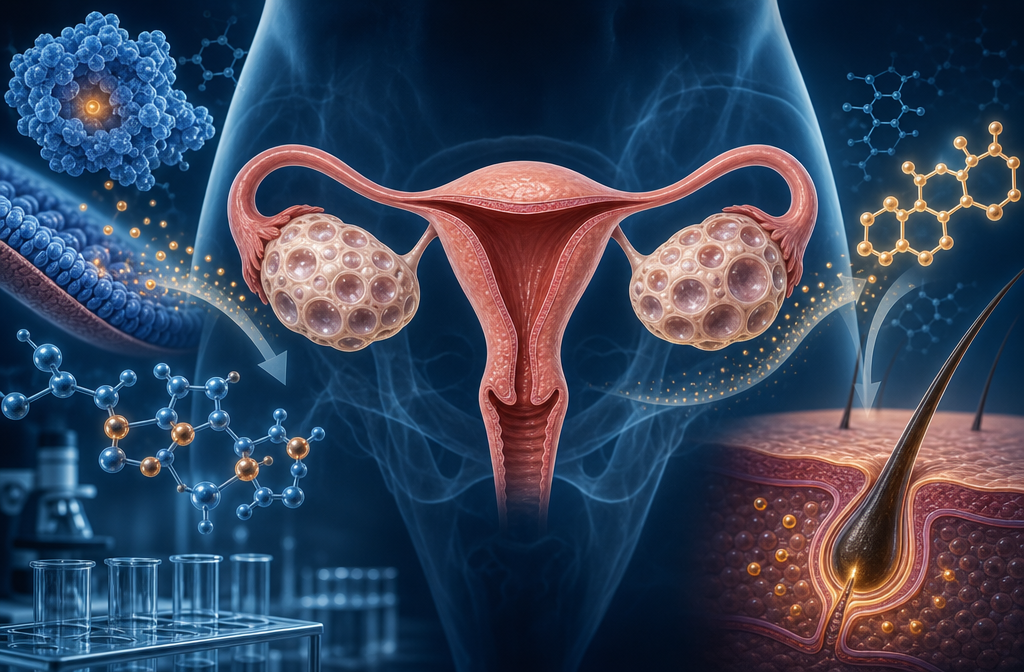
In PCOS, excess hair growth is triggered by elevated androgens — primarily testosterone and DHEA-S — produced by the ovaries and adrenal glands in response to insulin resistance and disrupted signaling from the pituitary gland. These androgens bind to receptors in hair follicles, converting fine vellus hairs into thick, pigmented terminal hairs in androgen-sensitive zones.
Here’s the biological chain of events:
- Insulin resistance develops — cells in the body stop responding normally to insulin.
- The pancreas compensates by producing more insulin (hyperinsulinemia).
- Excess insulin stimulates the ovaries to produce more testosterone than normal.
- High testosterone levels bind to hair follicle receptors on the face, chest, and abdomen.
- Follicles enlarge and shift from producing fine hair to coarse, dark terminal hair.
- Sex hormone-binding globulin (SHBG) drops, meaning more free (active) testosterone circulates in the blood.
This is why treating insulin resistance is often central to managing PCOS-related hirsutism — not just treating the hair itself. Understanding the first signs of reversing insulin resistance can be a helpful reference point for patients already in treatment.
How Do Hormone Levels Cause Hirsutism in Women?
Hirsutism in women results directly from androgens — hormones like testosterone, DHEA-S, and androstenedione — acting on hair follicles. Even mildly elevated androgen levels can cause significant hair growth if a woman’s follicles are particularly sensitive to these hormones.
Key hormones involved:
- Testosterone (total and free): The primary driver. Free testosterone is the active form not bound to SHBG.
- DHEA-S (dehydroepiandrosterone sulfate): Produced mainly by the adrenal glands. Elevated levels point toward adrenal causes.
- SHBG (sex hormone-binding globulin): Lower SHBG means more free testosterone is available to stimulate follicles.
- LH and FSH: Pituitary hormones that regulate ovarian androgen production. An elevated LH:FSH ratio is a classic PCOS marker.
- Prolactin: Elevated prolactin from a pituitary adenoma can also contribute to androgen excess.
- Cortisol: Excess cortisol from Cushing’s syndrome drives adrenal androgen overproduction.
Important: Some women develop hirsutism with androgen levels that fall within the “normal” lab range. This is called idiopathic hirsutism and reflects heightened follicle sensitivity rather than a measurable hormone excess. It still warrants evaluation.
Can Weight Impact Facial and Body Hair in PCOS?
Yes — excess body weight directly worsens hirsutism in PCOS by amplifying insulin resistance and increasing androgen production. The relationship is bidirectional: higher body fat raises insulin levels, which raises androgens, which worsens hair growth.
Research consistently shows that even a 5–10% reduction in body weight can lower free testosterone levels, raise SHBG, and reduce the severity of hirsutism in women with PCOS. This is one reason weight management is considered a first-line intervention alongside medication.
Why weight matters in this context:
- Adipose (fat) tissue produces estrogens and inflammatory signals that further disrupt hormonal balance.
- Visceral fat (around the abdomen) is especially linked to insulin resistance.
- Weight loss reduces hyperinsulinemia, which directly lowers ovarian testosterone output.
For patients in Queens who are managing PCOS and weight simultaneously, Atlantic Endocrinology’s weight loss clinic services in New York offer medically supervised programs that address both concerns together. You may also find it useful to understand how being overweight can cause joint and muscle pain, since PCOS-related weight gain often affects mobility as well.
Which Tests Help Diagnose the Root Cause of Hirsutism?
Diagnosing hirsutism requires blood tests, a clinical assessment of hair distribution (often using the Ferriman-Gallwey scoring system), and sometimes imaging. The goal is to identify whether the cause is PCOS, adrenal, thyroid, pituitary, or medication-related.
Standard diagnostic workup:
| Test | What It Identifies |
|---|---|
| Total & free testosterone | Overall androgen burden; elevated in PCOS and tumors |
| DHEA-S | Adrenal androgen excess |
| SHBG | Low levels increase free testosterone availability |
| LH and FSH | Pituitary function; LH:FSH ratio elevated in PCOS |
| Prolactin | Rules out pituitary adenoma |
| 17-hydroxyprogesterone | Screens for congenital adrenal hyperplasia (CAH) |
| TSH (thyroid) | Thyroid dysfunction can worsen hormonal imbalance |
| Fasting glucose & insulin | Assesses insulin resistance |
| Pelvic ultrasound | Visualizes ovarian cysts in PCOS |
| 24-hour urinary cortisol or dexamethasone suppression test | Rules out Cushing’s syndrome |
At Atlantic Endocrinology, our on-site laboratory services in Queens allow patients to complete most of this workup in a single visit, reducing delays between testing and treatment. Learning what to ask your doctor about PCOS before your appointment can help you get more from your first consultation.
What Are the Other Causes of Hirsutism Beyond PCOS?
PCOS accounts for the majority of hirsutism cases, but several other conditions can cause or contribute to excess hair growth. Identifying the correct cause changes the treatment approach significantly.
Other documented causes include:
- Congenital adrenal hyperplasia (CAH): A genetic enzyme deficiency that causes the adrenal glands to overproduce androgens. Non-classic CAH can mimic PCOS closely.
- Cushing’s syndrome: Excess cortisol stimulates adrenal androgen production. Symptoms also include central weight gain, stretch marks, and high blood pressure. See our overview of Cushing’s syndrome causes and treatment.
- Androgen-secreting tumors: Rare ovarian or adrenal tumors can cause sudden, severe hirsutism. Rapid onset of symptoms is a red flag.
- Hyperaldosteronism: An adrenal condition that can accompany androgen excess in some patients. Read more about hyperaldosteronism as a cause of hormonal imbalance.
- Thyroid dysfunction: Both hypothyroidism and hyperthyroidism can disrupt sex hormone balance and worsen hair-related symptoms.
- Hyperprolactinemia: Elevated prolactin from a pituitary adenoma can suppress normal hormonal cycles and elevate androgens.
- Medications: Anabolic steroids, valproate (for epilepsy), cyclosporine, minoxidil, and some progestins can trigger or worsen hirsutism.
- Idiopathic hirsutism: Normal hormone levels with increased follicle sensitivity. Diagnosed by exclusion.
Which Ethnic Groups Are Most Affected by PCOS-Related Hair Growth?
PCOS itself affects women of all ethnicities, but the expression of hirsutism varies significantly by genetic background. South Asian, Middle Eastern, Mediterranean, and Hispanic women tend to have higher rates of androgen-sensitive hair follicles, making hirsutism more visible and more common in these populations even at the same androgen levels.
East Asian women, by contrast, may have PCOS with significant metabolic features (insulin resistance, irregular cycles) but less visible hirsutism — which can sometimes delay diagnosis.
Clinical implication: Ethnic background should inform how clinicians interpret Ferriman-Gallwey scores. A score that indicates hirsutism in one population may be within normal range for another. This is why a personalized evaluation by an experienced endocrinologist matters more than relying on population averages alone.
Warning Signs That Hirsutism May Indicate a Serious Hormonal Problem
Most hirsutism is related to PCOS and is manageable, but certain features suggest a more urgent underlying cause that requires prompt evaluation.
Seek evaluation quickly if you notice:
- Rapid onset of hirsutism (weeks to a few months rather than gradual over years)
- Deepening of the voice or clitoral enlargement (signs of virilization)
- Severe acne combined with hair loss at the scalp
- Irregular periods that stopped suddenly after being regular
- Significant unexplained weight gain, especially in the abdomen
- High blood pressure combined with new hair growth
- A palpable abdominal or pelvic mass
These features may point to an androgen-secreting tumor or severe adrenal disease, both of which require imaging and urgent specialist care. An Endocrinologist PCOS Specialist in Queens, NY can order the right tests quickly and coordinate imaging through Atlantic Endocrinology’s on-site diagnostic services.

Treatment Options to Reduce Unwanted Hair Growth
Treatment for hirsutism targets both the cosmetic appearance of excess hair and the underlying hormonal cause. The most effective approach combines medical management with hair removal methods.
Medical treatments:
- Oral contraceptive pills (OCPs): Reduce ovarian androgen production and increase SHBG, lowering free testosterone. First-line for most women with PCOS-related hirsutism.
- Spironolactone: An androgen receptor blocker that reduces the effect of testosterone on hair follicles. Often combined with OCPs.
- Metformin: Reduces insulin resistance, which lowers androgen production in PCOS. Particularly useful when diabetes risk is present.
- Eflornithine cream: A topical prescription that slows facial hair growth by inhibiting an enzyme in follicles. Works best combined with laser treatment.
- GnRH agonists: Used in severe cases to suppress ovarian androgen production. Not a first-line option due to side effects.
Hair removal options:
- Laser hair removal: Targets melanin in the hair follicle. Requires multiple sessions and works best on dark hair. See a detailed breakdown of laser hair removal effectiveness for women with PCOS.
- Electrolysis: Destroys individual follicles with electrical current. Effective for all hair colors but time-intensive.
- Shaving, waxing, threading: Temporary cosmetic options that do not affect the underlying hormonal cause.
Choose medical treatment if: You want to slow new hair growth and address the hormonal root cause. Choose hair removal if you want to address existing hair cosmetically. Most patients benefit from both approaches simultaneously.
Can Birth Control Pills Help Manage Hirsutism Symptoms?
Yes — oral contraceptive pills (OCPs) are one of the most effective and widely used treatments for hirsutism caused by PCOS. They work through two mechanisms: suppressing LH-driven ovarian testosterone production, and increasing liver production of SHBG, which binds free testosterone and makes it inactive.
Patients typically see a gradual reduction in new hair growth over 6–12 months. OCPs do not remove existing terminal hairs — they slow or stop new growth, so hair removal methods are still needed for hairs already present.
Important considerations:
- Not all progestins in OCPs are equal. Some older progestins have mild androgenic activity and can worsen hirsutism. Low-androgenic or anti-androgenic progestins (such as drospirenone or norgestimate) are preferred.
- OCPs are not appropriate for women actively trying to conceive or those with contraindications such as a history of blood clots.
- For women who cannot use OCPs, spironolactone alone is an effective alternative.
Is Hirsutism Permanent, or Can It Be Reversed?
Hirsutism is not inherently permanent — but the degree of reversibility depends on how long the condition has been present and whether the underlying cause is treated. When androgens are elevated for years, some hair follicles become permanently converted to terminal follicles and will not revert to fine hair even after hormone levels normalize.
What can improve with treatment:
- Rate of new hair growth slows significantly
- Existing hairs may become finer and lighter over time
- Menstrual regularity and fertility often improve alongside hair changes
What may require ongoing management:
- Already-established terminal hairs in androgen-sensitive zones
- Follicle sensitivity that persists even after hormones normalize
This is why early intervention matters. Seeing an Endocrinologist PCOS Specialist in Queens, NY sooner rather than later gives you the best chance of preventing permanent follicle conversion. Laser hair removal can address existing hairs effectively, and you can learn more about how to choose a laser hair removal clinic to complement your medical treatment.
How Much Does Laser Hair Removal Cost for PCOS Patients?
Laser hair removal costs vary based on the treatment area, number of sessions required, and the clinic. For PCOS patients, more sessions are typically needed because active androgen excess can stimulate new follicles even after treated ones are eliminated.
General cost estimates (2026, New York area):
- Small areas (upper lip, chin): $150–$350 per session
- Medium areas (underarms, bikini line): $250–$500 per session
- Large areas (back, abdomen, legs): $500–$900 per session
- Full treatment course: typically 6–10 sessions, spaced 4–8 weeks apart
Most insurance plans do not cover laser hair removal for cosmetic purposes, even when hirsutism is medically documented. Some flexible spending accounts (FSAs) or health savings accounts (HSAs) may cover it when prescribed by a physician for a diagnosed condition — check with your plan administrator.
Important: Starting laser treatment before hormonal levels are controlled often produces disappointing results, because new hairs continue to grow. Coordinating laser treatment with your endocrinologist’s hormonal management plan gives you significantly better outcomes.
Natural Approaches to Reduce Excess Hair Growth with PCOS
Natural strategies can support — but not replace — medical treatment for hirsutism. They work primarily by improving insulin sensitivity, reducing inflammation, and supporting healthy adrenal function.
Evidence-supported lifestyle approaches:
- Weight loss: Even modest reductions in body weight lower insulin and androgen levels measurably.
- Low-glycemic diet: Reduces insulin spikes that drive ovarian androgen production.
- Regular exercise: Improves insulin sensitivity independently of weight loss.
- Spearmint tea: Some small studies suggest it may have mild anti-androgenic effects, though evidence remains preliminary.
- Inositol (myo-inositol and D-chiro-inositol): A supplement with growing evidence for improving insulin signaling in PCOS. Discuss with your physician before starting.
- Stress management: Chronic stress elevates cortisol, which can worsen adrenal androgen production. Supporting adrenal gland health through diet is a useful complementary strategy.
The honest limitation: Natural approaches alone rarely produce dramatic reductions in established hirsutism. They work best as part of a comprehensive plan that includes medical evaluation and, when appropriate, prescription treatment.
Finding an Endocrinologist PCOS Specialist in Queens, NY
If you’re experiencing hirsutism, irregular periods, unexplained weight gain, or acne — especially in combination — a PCOS evaluation with a board-certified endocrinologist is the right next step. General practitioners can initiate a basic workup, but complex hormonal presentations benefit from specialist-level interpretation.
At Atlantic Endocrinology & Diabetes Center, Dr. Stella Ilyayeva, M.D., brings over 20 years of experience in endocrine disorders including PCOS, adrenal disease, and thyroid dysfunction. The practice also includes Dr. Moisey Fridman, M.D., Ph.D., in Obstetrics & Gynecology, making it possible to address both the hormonal and reproductive dimensions of PCOS under one roof.
Locations serving Queens residents:
- Rego Park: 97-25 63 Dr 1 FL, Rego Park, NY 11374 | Mon–Thu: 9 AM–7 PM | Fri: 8 AM–5 PM | Sun: 8 AM–6 PM
- Forest Hills: 99-45 67th Rd Suite 103, Forest Hills, NY 11375 | Mon, Tue, Thu: 9 AM–5 PM
Insurance accepted includes Aetna, Cigna, EmblemHealth, Healthfirst, Medicaid, Medicare, United Healthcare, Fidelis Care, and many others.
📞 Call (718) 275-2900 or contact Atlantic Endocrinology online to schedule your evaluation.
Frequently Asked Questions
What is the most common cause of hirsutism?
PCOS is the most common cause, responsible for approximately 70–80% of cases. It causes hirsutism through elevated androgens driven by insulin resistance and ovarian hormone imbalance.
Can hirsutism go away on its own?
Rarely. Without addressing the underlying hormonal cause, hirsutism typically persists or worsens over time. Treatment significantly slows or stops new hair growth, but existing terminal hairs usually require removal methods.
Is hirsutism dangerous?
Hirsutism itself is not dangerous, but it signals an underlying hormonal imbalance that may carry risks — including infertility, metabolic syndrome, and cardiovascular disease — if left untreated.
What blood tests are done for hirsutism?
A standard workup includes total and free testosterone, DHEA-S, SHBG, LH, FSH, prolactin, TSH, 17-hydroxyprogesterone, and fasting insulin and glucose levels.
A Clinical Approach to Hirsutism and Underlying PCOS
Hirsutism is a meaningful clinical symptom, not simply a cosmetic concern. In most cases, it points to PCOS and the androgen excess that comes with insulin resistance — a hormonal cascade that affects far more than hair growth, touching fertility, metabolism, and long-term cardiovascular health. The good news is that with the right diagnosis, hirsutism is manageable and, in many cases, significantly reversible.
The path forward starts with a proper hormonal evaluation. If you’re a woman in Queens experiencing unwanted facial or body hair — especially alongside irregular periods, acne, or weight changes — an evaluation with an Endocrinologist PCOS Specialist in Queens, NY is the most direct route to answers and effective care.
Atlantic Endocrinology & Diabetes Center offers comprehensive PCOS evaluation, on-site laboratory services, and multidisciplinary care across multiple Queens locations.
📞 Call (718) 275-2900 or visit atlanticendomd.com/contact to schedule your appointment today.
Sources
- Spritzer, P. M., Marchesan, L. B., Santos, B. R., & Fighera, T. M. (2022). Hirsutism, normal androgens and diagnosis of PCOS. Diagnostics, 12(8), 1922.
https://www.mdpi.com/2075-4418/12/8/1922
- Azziz, R., Amiri, M., Bril, F., Joham, A. E., Kelestimur, F., Ottey, S., … & Zhao, X. (2025). Approach to the patient: hirsutism. The Journal of Clinical Endocrinology & Metabolism, 110(10), e3503-e3519.
https://academic.oup.com/jcem/article/110/10/e3503/8108889?guestAccessKey=
Medical and Editorial Commitment
The content of this article is strictly for educational and informational purposes. It does not replace in-person professional medical diagnosis, advice, or treatment..
Read Privacy PolicyRelated Posts
Treatment for Neuropathy in Legs and Feet: A Complete Guide for Patients Seeking in Queens, NY
Last updated: June 11, 2026 Quick Answer: Diabetic neuropathy in the legs and feet is nerve damage caused by chronically high blood [...]

Vitamin D3 vs D2 for Bone Health: Which Is Better? A Guide to Bone Specialist Services
Last updated: June 4, 2026 Quick Answer: Vitamin D3 (cholecalciferol) is the superior choice for bone health. It raises and maintains blood [...]