
 By Atlantic Endo Medical Review Board
You’ve just taken a radioactive pill to evaluate your gland’s health. But as you leave the clinic, a critical question arises: are you currently putting your loved ones at risk? The exact timeline for this radiation to clear your system might actually surprise you. Before scheduling your thyroid scan in Queens, NY, know exactly how long you are radioactive after a thyroid uptake scan is required. Let’s uncover the truth.
TL;DR
The minimal radioactivity from a safe thyroid scan typically clears through your urine within 2 to 3 days. You can immediately resume normal activities, but for the first 48 hours, ensure you drink plenty of fluids and follow basic precautions like double-flushing the toilet and taking necessary steps for air travel or breastfeeding.
Contact us for Thyroid scan in Queens, NY help
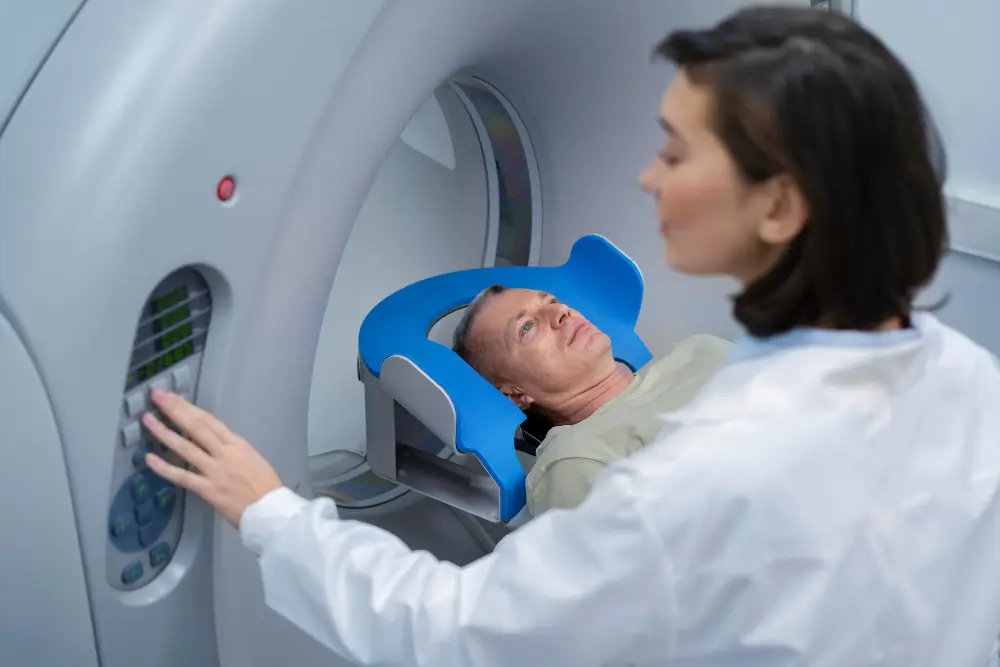
Table of Contents
How Does a Thyroid Uptake Scan Work in the Body?
A thyroid scan is a safe and accurate study that uses a minimal amount of radioactive material to evaluate the gland. This procedure stands out because it does not require strict fasting, although prior consumption of iodine or contrast agents must be reported.
After the tracer is administered orally or by injection, the thyroid naturally absorbs it from the blood. After waiting a period of 4 and 24 hours, a special gamma camera detects the emitted rays to map thyroid activity.
The images obtained reveal hyperactive or hypoactive zones, allowing for the diagnosis of conditions like hyperthyroidism, nodules, or cancer. Additionally, side effects are extremely rare, occasionally limited to mild allergic reactions or injection site discomfort.
Radioactive Tracer Administration Process
The radioactive tracer administration process for a thyroid scan is designed to evaluate the structure and function of the thyroid gland. Thanks to this tracer, a gamma camera can detect the emitted radiation and generate detailed images of the area.
- Technetium-99m can be used intravenously; it is the most common tracer due to its low cost, high availability, better image quality, and lower radiation exposure.
- Another option is Radioactive Iodine (Iodine-123 or Iodine-131, the latter used more frequently for therapy) administered orally by ingesting a liquid or capsule.
Regarding preparation, strict fasting is generally not necessary, although it is recommended when an iodine-131 scan is performed. Inform the staff if you are taking thyroid medications, iodine products, or supplements, as they may interfere with the results.
Thyroid Iodine Absorption Measurement Phase
This nuclear medicine procedure quantifies the amount of radioactive iodine that the thyroid gland absorbs from the blood. This phase is usually performed along with gamma-ray imaging to evaluate both thyroid function and structure.
The procedure for measuring iodine uptake consists of the following steps and characteristics:
- Administration: The patient ingests a capsule or a liquid containing a minimal amount of radioactive iodine.
- Measurement Times: Two measurements are usually taken after ingestion to assess the peak absorption: an early one (4 and 6 hours) and a late one (at 24 hours).
- Technique: A specialist places a gamma probe over the patient’s neck, which detects the radiation emitted by the thyroid.
- Duration: Each measurement is a quick process that takes approximately 15 minutes and is completely painless.
- Calculation: A computer calculates the percentage of radioactive iodine that has been retained in the thyroid, comparing it to the initial dose that was administered.
It provides precise percentages that are critical for the final medical diagnosis. By evaluating whether the values retained by the gland are normal, high, or low, it is possible to clearly identify if the patient has hyperthyroidism, inflammation (tiroiditis) or any damage to the area.
Gamma Camera Imaging Procedure Steps
The gamma camera imaging procedure, or scan, is a process that follows a series of meticulous steps to ensure diagnostic accuracy.
| Procedure Phase | Description |
| Prior Preparation | Instructions are given regarding fasting or hydration, and a medical interview is conducted to review medical history, allergies, or pregnancy. |
| Administration | A small amount of radioactive material is introduced into the body to travel and attach to the organ of interest. |
| Waiting Time | The patient waits the necessary time (minutes or even days) for the tracer to be distributed and correctly absorbed. |
| Image Acquisition | The patient remains lying down and still while the gamma camera detects the radiation during a short scan. |
| Finalization | The specialist evaluates the images, and the patient may leave. |
In the finalization stage, the specialist checks the quality of the images, after which the patient can get up and leave. Finally, drinking water is recommended to speed up the elimination of the tracer from the body.
Radiation Decay and Clearance Timeline
The exact timeline for decay and clearance of radioactivity from the body depends directly on the type of tracer used during the study, the main ones being Technetium-99m and Radioactive Iodine.
- Technetium-99m: Half-life ~6 hours; mostly eliminated in 24 hours; very low radiation (disappears in 1–2 days); images 5 and 30 minutes after injection
- Radioactive Iodine: Half-life of 13.2 hours (I-123) and 8 days (I-131); elimination via urine in 24–48 hours; the tracer is administered and the study is performed 6 and 24 hours later
To ensure safe and effective elimination of the radioactive material from the body, the following care and precautions are recommended:
- Elimination Route: The tracer is eliminated from the body primarily through urine.
- Recommendations: Drink plenty of fluids (1 and 2 liters) after the test. This helps accelerate the natural process of tracer elimination.
- Precautions: Double-flush the toilet after urinating, especially during the first 24 to 48 hours after the material is administered.
- Isolation: Normally, for diagnostic scans, no special long-term isolation precautions are required once the first 48 hours have passed.
The tracers used in scans are safe and cleared from the body quickly. Technetium-99m allows for rapid imaging with minimal radiation, while radioactive iodine is used in more specific studies, such as thyroid scans, with longer evaluation times.
Post Scan Safety Guidelines and Precautions
You can resume your normal activities, as most of the radioactivity disappears from the body in a period of 2 to 3 days. If you are scheduled to travel by plane or cross borders, carry your medical documentation, as detectors might be activated.
Specific precautions exist depending on the patient; for example, if you are nursing, you may need to temporarily suspend breastfeeding and discard pumped milk. Likewise, studies using radioactive iodine may require much more specific restrictions.
Although adverse effects are very rare, you must contact a professional regarding any anomaly. Seek medical attention if you experience allergic reactions such as a rash or itching, or if pain and inflammation persist at the injection site.
Key Takeaways
- Procedure Purpose and Safety: This highly safe scan uses minimal radioactive material to evaluate the gland without strict fasting. It accurately detects hyperactive or hypoactive zones to diagnose thyroid conditions. Side effects from this process are extremely rare.
- Radioactive Clearance Timeline: The exact clearance timeline depends on the specific tracer used. However, most radioactivity disappears from your body within two to three days. This residual material is primarily eliminated through your urine.
- Post-Scan Hydration and Hygiene: You can resume normal activities, but specific safety precautions are necessary for the first 24 to 48 hours. Drink plenty of fluids (one to two liters) to help accelerate clearance. Additionally, practice careful bathroom hygiene by flushing the toilet twice.
- Special Precautions and Travel: Nursing mothers may need to temporarily suspend breastfeeding and discard pumped milk. If you plan to travel by plane, carrying your medical documentation is highly recommended. This is necessary because residual radiation might trigger airport security detectors.
FAQs
Why would a doctor order a thyroid scan?
A doctor orders it to evaluate the thyroid gland’s shape, size, and position, which helps identify the causes of hyperthyroidism, evaluate nodules, or detect cancer.
What are early warning signs of thyroid cancer?
Main early warning signs include the appearance of a hard, painless lump in the neck, persistent hoarseness, swollen lymph nodes, and difficulty swallowing or breathing.
What is a red flag on a thyroid ultrasound?
Warning signs on an ultrasound include hypoechoic (darker) nodules, microcalcifications, irregular margins, and a taller-than-wide shape, all of which suggest a higher risk.
What does a thyroid scan consist of?
It consists of administering a minimal, safe amount of a radioactive tracer (iodine or technetium) that the thyroid absorbs, followed by generating detailed images of its activity using a gamma camera.
Sources
- Cheng, K., & Presswala, L. S. (2024). Thyroid uptake and scan.
https://books.google.com.co/books?
- Wu, K., Ozomaro, U., Flavell, R., Pampaloni, M., & Liu, C. (2021). Causes of false-positive radioactive iodine uptake in patients with differentiated thyroid cancer. Current Radiology Reports, 9(6), 6.
https://link.springer.com/article/10.1007/s40134-021-00381-7
You May Also Like
- What to Expect at Your First Endocrinologist Appointment for Thyroid
- What Do Endocrinologists Test For?
- When to Worry About Thyroid Nodules: Symptoms, Risks & When to See a Doctor
Medical and Editorial Commitment
The content of this article is strictly for educational and informational purposes. It does not replace in-person professional medical diagnosis, advice, or treatment..
Read Privacy PolicyRelated Posts
Are All Suspicious Looking Nodules on Thyroid Sonogram Malignant?
Seeing a suspicious-looking nodule on your thyroid sonogram can immediately raise the question: Is it cancer? Many patients jump to the worst [...]
Does Fundoscopy Tell Us About Lymphoma?
What if a simple eye exam could reveal clues about conditions far beyond your vision? Fundoscopy is often used to examine the [...]